Author Archives: jm

What if there are a lot of bikes?

In some cities like Amsterdam (The Netherlands), there is a problem with so many bicycles on streets. Amsterdam has built at least two mega-parking next to the Central Train Station, another at the Dam square and the third at Leidseplein, to name a few. Still, when celebrating an important event there is the need of increasing safe parking for bikes. In such cases, there is the possibility of creating a parking for thousand of bicycles in a fast way in order not to use cars.

Moreover, they made a test in Pijp, the highest density neighbor in Amsterdam, consisted in painting rectangles on the soil. This proposal by the local cyclist association (Fietsersbond) reduced the sidewalk obstruction and improved the urban living. After it, the neighbor erased car parking so today shows the best equilibrium between density and accessibility. Additionally, there are places specifically designed for cargobikes since they overcome the standard bike measures.

On the other hand, some 24-h commercial premises work as public bicycles parkings and storage boxes for 5 bikes which have a shared key to the neighbor in Rotterdam (The Netherlands). This way there are less bicycles hindering sidewalks.
Walloon

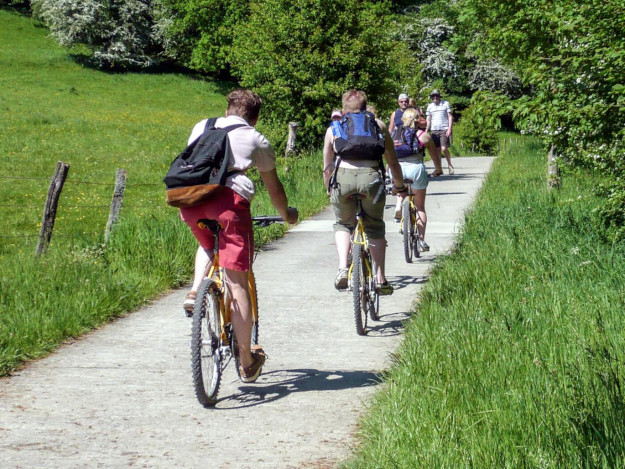
Walloon (Belgium) is an attractive cyclist destiny with more than 1,800 kilometers of RAVeL, several bike paths with different levels, and about 800 Bienvenue Vélo agents (safe hotels to lock your bike) to make your bike-tourist trip comfortable. Indeed, four EuroVelo cross the zone. Thus, there is a myriad of landscapes to enjoy, from the forest region of Ardennes to the Canal du Centre (Heritage of Humanity) and its four hydraulic elevators. Moreover, there are bike shops, multi-services companies and ebike charging points.

RAVeL means Slow Paths Autonomous Net, or in other words more than 1,800 kilometers for pedaling, 45 itineraries that connect to fourteen national and international routes. You can complete the lakes tour of Eau d’Heure or the VennBahn route. Regarding History, villages such as Fagnolle and Falaën make it well worth the effort as well as the Durbuy and Dinant cities.

CREATOR: gd-jpeg v1.0 (using IJG JPEG v90), quality = 75

BSF

Bicycles have been using for more than pedaling and one of the alternative uses is helping people lives. I wrote about Soterranya and its impressive work by recovering bikes in bad state, fixing them and donating them to persons who need them. At the time of writing this post, Soterranya has given more than 3,000 bikes and actively participated in the recovery from the Valencia, Spain, DANA in the next months after October 2024 in those villages more negatively affected.

Another inspiring example is BSF (Bicicletas Sin Fronteras, Bicycles Without Frontiers) (https://www.bicicletassinfronteras.org/, in Spanish). It was born in 2015 and has donated more than 2,700 bikes to the Senegal population. Its aim consists in helping local people by giving bicycles to students, instead of walking kilometers to school, to improve their academic performance, promote employment and strengthen communities to them. Their baobikes system is locally managed. All in all, the most complicated was to change the white-man mentality, and understand and adapt to their local culture. Romà Boulé, the BSF responsible, affirms that they have received requests from other countries, but he remarks the need of local entities which know the area, and have enough technical knowledge and economic support for such a project.

Riding close to leaves?

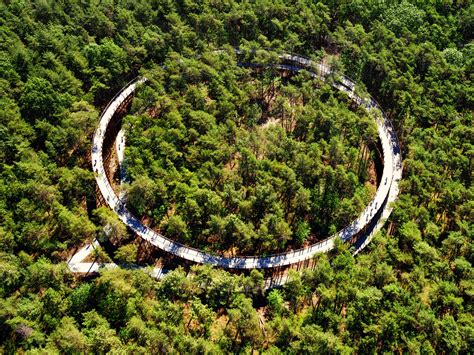
Riding a bike has direct impact in protecting environment and trees. The relation between bicycles and trees is expressed to a higher degree at the Bosland National Park (Belgium). Here, not only you can pedal close to trees, but also close to its leaves. This is due to a special bike line between Lommel, Hechtel-Eksen and Pelt known as Fietsen door de Bomen or Cyclign through the Trees. This massive bike circle has a slope of 3% – 4%, is 700 meters long and one 3 meters unidirectional line.

The perfect integration of this infrastructure and nature makes the experience magical. Its designers tell proud that they had in mind flora and fauna respect to determine the bike line. Additional technical issues like the use of minimal machine in the national park or the final ensemble were also put into practice. A metal mesh protects bikers from falling from the top of the bike line.

Different Sundays

Every Sunday in Bogota, Colombia, is different thanks to Ciclovia. From 7 a.m. to 2 p.m., streets become more human, quieter and peaceful. Ciclovia was born 50 years ago when the independent organization Pro-cicla closed the first streets to pollutant vehicles on 15th December 1974. It congregated 5,000 people who protested against pollution, cars and lack of leisure alternatives in the city. In June of 1976, the mayor made it “official” through decrees 566 and 567. As time passed by, the number of kilometers for people on Sundays diminished to 20, until Ciclovía was managed by the Secretaría de Tránsito y Transporte and the Instituto Distral de Recreación y Deporte. Today, more than 80 kilometers are closed every Sunday. Even more, there is the Ciclovia Nocturna (Night Ciclovia) which consists in closing streets twice in August and Christmas. It started in December 1999 and three million people enjoyed it.

As it comes to the types of people who take advantage of Ciclovia, the earlier risers are the cyclist who preferred making sport since they go to Patio, Guadalupe and Montserrate hills. Next, families with children use streets as playing grounds. After them, other bikers, skaters, senior citizens and walkers join the celebration. Finally, food sellers, gymnastic groups and sometimes live concerts contribute to make it a party.

The success of this event goes deep into transforming an area into a democratic and universal surface. Not surprisingly, it has been exported to other cities within Colombia, Chili, Mexico and USA.

The path

How would our cities be if car did not dominate them?

Today, most of cites are mastered by cars which product pollution, noise, dead cashes and less surface for people. If the XX century had been different and vehicles such as bicycles, buses or trains would be opted for, I assure you that there would be far less car fatalities, people would have better health and psychology, climate change could be no problem today, children would still play on streets, adults would enjoy streets and neighbor relationships more, extracted energy from Earth would be less, wildlife would be higher and perhaps more diverse, local stores would sell more as people cycling and walking have time to see the products they sold versus people in cars who does not have time enough to focus or even see products that stores sell. They told cars improve safety in cities, but this is not true. Some examples that demonstrate it are:

– Curitiba (Brazil): For its urban planning, not focused on cars

– Copenhagen (Denmark): For its urban infrastructure and cyclist planning

– Vancouver (Canada): For its example on shared mobility

– Singapore: For its accurate tax system for vehicles

– Zurich (Switzerland): For a good-thought, public transport system

Can AI help to promote urban biking?

Every day we read a piece of news related to advances in Artificial Intelligence (AI). A lot of fields are taking advantage of it in order to automate processes, show a more precise analysis or creating new materials, just to name a few. Can AI help to promote urban biking?

As you could imagine, the answer is yes. In a few words, AI plays a significant role in promoting biking by enhancing safety, convenience and awareness for cyclists. Some ways to reach them are:

  • Smart route planning: AI algorithms analyze real-time traffic data, weather conditions and infrastructure to suggest the safest and most efficient biking routes. This makes more people to use cycling over other modes of transport

  • Traffic management and optimization: When a biker is in charge of deciding which traffic systems are better for bike users and has in mind AI, she usually determines that AI-powered traffic systems are suitable to prioritize bike lanes, optimize traffic light timings and reduce congestion. When this point is used in urban biking, it becomes safer and more appealing

  • Safety monitoring and alerts: AI can facilitate the development of wearable devices and bike sensors that detect hazards, monitor urban cyclist health and send alerts about approaching vehicles of unsafe street conditions

  • Bike sharing optimization: Although bike sharing systems are common in many cities around the world, AI can analyze usage patterns to optimize the placement and availability of shared bikes, making bikes more accessible and convenient for users

  • Public awareness campaigns: Apart from human thinking, AI-driven data analytics can identify barriers to cycling adoption and tailor targeted campaigns to address misconceptions, promote health benefits and inform citizens about cycling infrastructure

  • Infrastructure planning: Urban planners can use AI as assistant by analyzing data on traffic flow, accident hotpots and commuter patterns to design better bike lanes, bike parking and facilities

  • Personalized incentives: AI systems can offer personalized rewards or incentives for cycling to work or study. This way more city residents are encourage to incorporate biking into their daily routines

All these points are examples of how cities can create a safer, more efficient and more attractive environment for urban biking by using AI, leading to healthier populations and more sustainable urban development.

The cuentakilómetros

Some times politicians promise new bike lines in political campaigns and after they win the elections, they mysteriously forget what have announced thus cheating on their voters. Cities inhabitants have two options: Make as nothing happened or fight for the promised bike lines. Regarding the second point, there is un action, the Cuentakilómetros (in Spanish) originally created in Málaga (Spain) and replicated for other cities. It consisted in using an interactive map with a progress bar in Google Maps in which one could see the evolution of bike lines being built.

The urban bike group Ruedas Redondas was upset about the promise that the mayor proposed in the political campaign (to double the number of bike lines kilometers in Málaga, from 45 to 90) and the lack of pieces of news on media about the new projects and on the streets. So, they created the Cuentakilómetros (the technological tool that I have commented) for every person to see how the evolution was. For this gentle way of showing reality, Ruedas Redondas only had to check media and public trading platforms for newness and update it. This way, cyclist could see the evolution of bike lines creation and confirm that it is impossible to trust on politicians who promote motor vehicles instead of bicycles under a climate change challenge. Smart people will remember the lack of such bike lines when voting again.

Ideas for governments and companies

It is well-known that going to work by bicycle is good for the glucose and cholesterol levels, stress reduction, good mood and productivity increment. Indeed, according to the Dutch Ministry of Infrastructures 80% of workers who pedal to work show a better compromise between companies and their jobs, and their work absenteeism diminishes. Moreover, diabetes is reduced by 20%. Not surprisingly, open-minded governments promote the use of bicycles with strategies such as giving social benefits to workers who buy bikes through firms (these get tax reductions), those workers who ride to the office obtain money per pedaled kilometer, urban biking promotion not only the Day of the Bike but 365 days in a year, a day for bike maintenance, free subscription to public bikes, bike lines and bicycle parking building. In return, sanitary costs are reduced and environment improves not only because bikes do not pollute in the using stage, but also as a result of if a person uses a bike instead of a car she provokes the same emissions diminishing as one tree every month.

Can a bicycle owner be determined by her bike?

This is a thought that I have been chewed on it for a time. It implies that given all the different bike types and accessories, they tell about their personality and interests owners somehow. Indeed, when you periodically meet bikers from time to time, for instance in the Critical Mass, you could not remember the name of each and every cyclist if it is a numerous group. But you recognize them by their bicycles if you have previously seen their possessors, even if you have not meet them for a long time giving they still maintain the same bike. Personality is shown through bike kinds (mountain bike – a person who enjoys riding mountains, hybrid bike – possibly somebody who does bike-tourism, road bike, etc.) and accessories (bicycle basket – there is or has been a child, saddlebags – a bike-tourist, rear-view mirror – somebody who usually pedals on car lines…).